
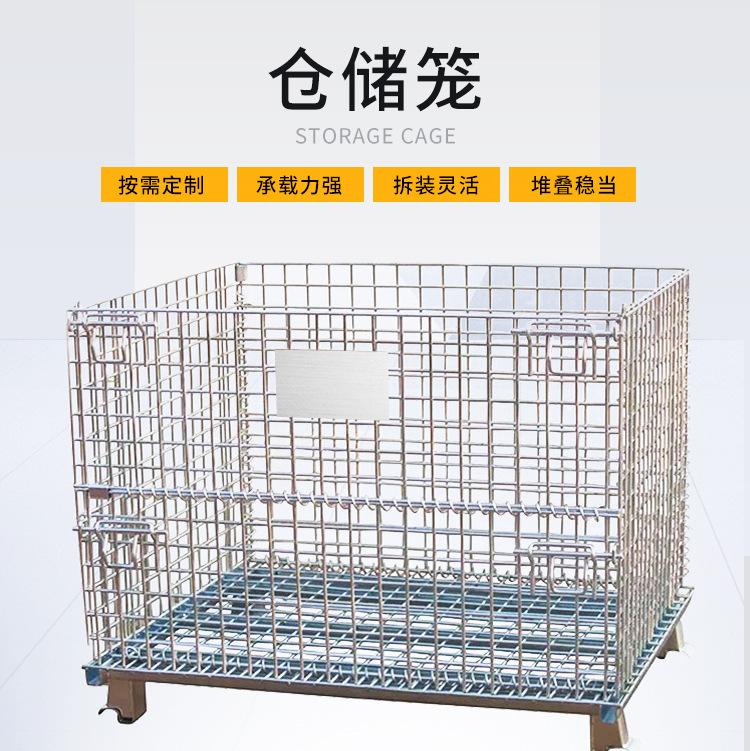
As a standard logistics tool, warehouse cages are widely used in auto parts, machinery and electronics, metal castings, and logistics and storage. As demand grows, more makers enter the market and prices vary widely. Judging a cage should not start and end with price. Xintongnuo suggests checking four points: what raw material is used, whether workmanship is consistent, whether the structure is stable, and whether the galvanizing is done well. A good cage should hold up through every situation its goods meet in packaging, storage, turnover, and transport. The cage structure is not complex: apart from the bottom frame, the main body is mesh panels spot-welded from wire, connected panel-to-panel and panel-to-frame by small movable fittings. Empty cages fold flat to use space fully; the front opens so goods can be picked even when stacked; the load rests on four upright posts during stacking. Because cages stack, fold, and move, they became a standard container in logistics flow. How is quality guaranteed? In production, the risk is makers skimping on raw material to save cost. Xintongnuo holds the quality line in production, because consistent quality is the only way to supply customers steadily over the long term. If your materials are special and standard sizes fall short, Xintongnuo can also do non-standard customization.